

Banc De Binary Trading Competition
If yous're the strategist behind a multibillion dollar scam that rips off hundreds of thousands of people worldwide, one of the key challenges you face is managing your online reputation. How do you forbid defrauded clients from warning others about their appalling experiences?
This is the quandary faced past fraudsters in the binary options industry, which operates on the assumption that at some point potential clients will do a search for "Is binary options a skillful investment?" or "Is XYZ Binary Options Brand a reputable visitor?" To prevent the truth from getting out, the fraudulent firms need to comprehensively control what potential investor-victims meet online.
The Times of Israel, in a series of articles, has exposed the largely fraudulent State of israel-based industry that has been stealing billions of dollars from hundreds of thousands of victims worldwide for the past decade. Duplicitous binary options companies ostensibly offer customers a potentially assisting brusque-term investment, but in reality — through rigged trading platforms, refusal to pay out and other ruses — these companies fleece the vast majority of customers of most or all of their coin. (The industry has been denounced by State of israel'south securities regulator and by the Prime Minister's Function, and a authorities-drafted, opposition-backed bill to ban information technology was sent in Feb to the Knesset, where it currently languishes.)
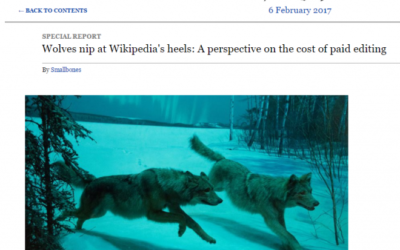
A screenshot of the February 2017 Signpost article detailing Wikipedia editors' battle with Banc de Binary.
For a normal business or industry it would be hard to keep undercover a track record of vast global theft. But the binary options industry is unrelenting in its ambition to control the catamenia of data about itself. Several months ago, an article appeared on Signpost, the internal publication of Wikipedia editors, showing the extreme lengths the boosters of just one binary options house went to in lodge to bury information well-nigh the company's troubles with regulators.
Entitled "Wolves nip at Wikipedia's heels: A perspective on the cost of paid editing," the article describes the exhausting battle waged by volunteer Wikipedia editors against apparent flacks for Banc De Binary, an Israeli binary options firm which, until it closed its doors several months ago, was considered a flagship of this industry.
An encyclopedia that assumes goodwill
In its aims and founding philosophy, Wikipedia is the antonym of the fraudulent binary options manufacture mindset. Founded in 2001 past Jimmy Wales, the online encyclopedia grew out of the American open-source software movement, which rests on the assumption that people will interact on a project without being paid to do and then, out of an altruistic want to produce something of value that benefits all. Anyone can edit Wikipedia, and much of its success relies on strangers around the world upholding the community's trust.
Due in large office to this optimistic view of homo nature holding true, Wikipedia has been a success to the point where it is now the fifth-most visited website in the world. Only this success has attracted many actors who seek not to enhance homo understanding simply to promote themselves, sometimes for illegitimate ends.

Wikipedia logo
For instance, in a much-publicized 2013 incident, accounts allegedly belonging to employees of a company chosen Wiki-PR, which wrote Wikipedia manufactures and edited pages on behalf of large corporate clients, were blocked and removed from the site.
"Information technology looks similar a number of user accounts — perhaps every bit many as several hundred — may take been paid to write manufactures on Wikipedia promoting organizations or products, and take been violating numerous site policies and guidelines, including prohibitions against sockpuppetry and undisclosed conflicts of interest," Wikimedia Foundation director Sue Gardner said in a argument on October 21, 2013.
But as the recent Signpost commodity makes clear, the problem of paid editing has not gone away. And some of the worst violators are retail forex and binary options companies, Smallbones, the author of the Signpost article and an editor at Wikipedia for the past 11 years, told The Times of Israel in a telephone interview. (The Times of State of israel knows the identity of Smallbones, a retired professor of finance living in the United States, but he requested that his real name not exist used here in an effort to minimize the harassment, both online and off, that he has experienced as a result of writing near the issue of paid editing.)
"We very normally get people trying to insert advertisements into articles," the Wikipedia editor said. "Only this Banc De Binary article is by far the worst case I have ever seen."
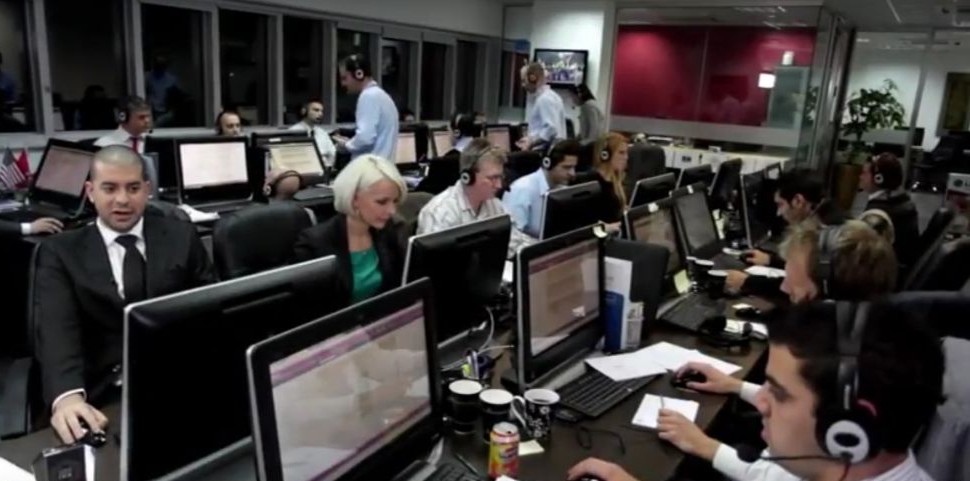
A screenshot from a 2013 promotional video for Banc de Binary, since removed from the internet (Youtube)
Banc de Binary's website first appeared online in about 2010. In the aforementioned year, a human being by the name of Oren Shabat registered the Israeli firm Due east.T. Binary Options Ltd., an Israeli visitor that operated a call center and managed Banc de Binary. The company, which later changed its proper name to E.T.B.O. Services, is owned by Oren, his father Hezi and his brother Lior Shabat, according to Israel's corporate registry. A smaller portion of the visitor's shares are held in trust for Yossi Almaliach, Ronen Tubul, Ohad Tzori and Yoram Menachem.
Banc De Binary's Wikipedia article was posted in 2012. At the time, the company billed itself equally a group of "private options bankers" and claimed to be located at 40 Wall Street in New York City. (The company reportedly had a "virtual office" at that place. This address, known as the Trump Building, has been used by other binary options-associated firms similar the SEC-sanctioned EZTrader and the due east-wallet service Neteller).
By 2013, the article had been deleted twice by Wikipedia administrators "for existence purely promotional and thus violating Wikipedia's policy against advertisements," Smallbones said, but the article kept reappearing and would go a focus of frenzied editing. Wikipedia editors too conducted an investigation that led to the banning of the article'due south original creators equally "sockpuppets," an internet term for users who presume multiple identities for purposes of deception.
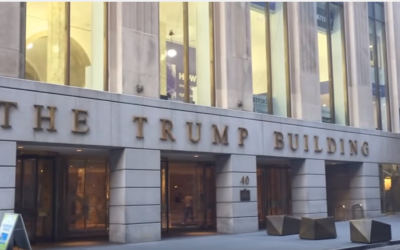
Initially, Banc De Binary claimed to have an office at 40 Wall Street (Youtube screenshot)
In addition, a biography of Banc de Binary's founder Oren Shabat (who has adopted the name of Oren Laurent) was deleted by other editors iii times in 2013 due to perceived promotional content or because the article'south discipline was considered "non notable."
Smallbones explained that it is common practice for editors to suggest deleting Wikipedia manufactures that seem to have been created for purposes of self-promotion or advertizing and that lack objective information from a reliable news source.
"The terms of utilize for Wikipedia and for almost all the websites run past Wikipedia's parent, the nonprofit Wikimedia Foundation, incorporate a simple provision regarding paid editing," he said. "All paid editors must declare that they are paid and who is paying them, thus allowing volunteers to monitor and alter whatsoever paid edits. Undeclared paid editors are not allowed to contribute to any of these sites. Advertizing, marketing, and public relations text is prohibited by Wikipedia policy."
In add-on, editors with a disharmonize of involvement (for case, individuals editing their own Wikipedia pages) are strongly discouraged from working on those articles where they cannot be objective. However, they are permitted to make suggestions on the talk page.
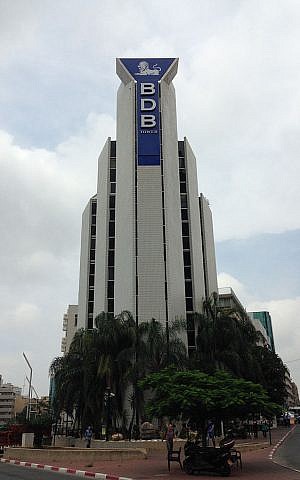
The Banc de Binary Tower in Ramat Gan in 2014 (CC BY-SA BDBJack, Wikipedia)
According to Smallbones, the flurry of activity surrounding the Banc De Binary article began when the Usa government filed ceremonious charges against the company in June 2013, accusing information technology of illegally offering US investors binary options without beingness registered.
John Berry, a senior lawyer for the U.S. Securities and Exchange Commission, said in a May 2016 interview with BBC radio that non but had Banc De Binary sold ostensible financial products to investors without being licensed to do so, just information technology had deceived those investors as well:
"We presented evidence to the court that Banc De Binary was telling United states of america-based investors that Banc De Binary was actually based on Wall Street, and we had evidence of online chat discussions where a Banc De Binary broker would tell a Usa investor, 'Hey, I live, yous know, right down the street from Wall Street, I've got a Wall Street address, I piece of work there,' and then they had repeatedly lied to US-based customers about being in the United States and being based in the Usa with a US address on Wall Street and a New York-based phone number."
In March 2016, the company was ordered by a United states of america court to pay over $11 million in restitution and penalties for illegally soliciting U.s. customers.
Regulators in Australia, New Zealand and Canada have issued warnings against Banc De Binary for illegal activity. Some other make that appears to exist associated with Banc De Binary, Option.fm, has been blacklisted by financial regulators in Ontario, Hong Kong, Commonwealth of australia and New Zealand. Banc De Binary was also fined €350,000 ($370,500) by CySEC (the Cyprus Securities and Commutation Commission) in January 2016.
Two days after the Usa merits against Banc De Binary in 2013, the information about it went upward on Banc De Binary's Wikipedia page. Over the side by side eleven months, over 500 edits would be made to the article, an unusually high number. According to the Signpost commodity, over 20 separate sockpuppets were banned from Wikipedia later editing this article.
Smallbones said that the "edit wars" surrounding the Banc De Binary article mainly involved certain editors removing information about the CFTC claim or moving it to the bottom of the article, while other editors would move the information dorsum to the peak. The get-go two sentences of any Wikipedia article are of paramount importance considering they announced prominently in what is known as a "knowledge box" on the right-hand side of a Google search results page.
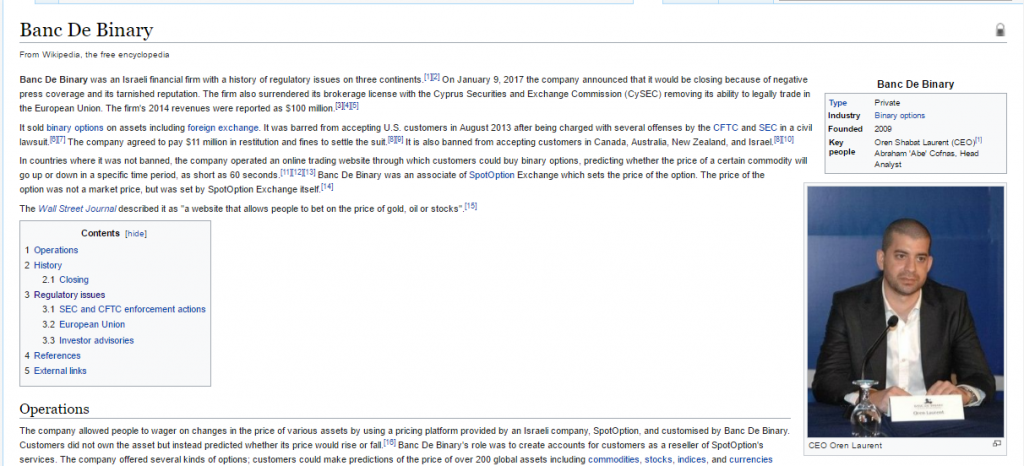
A screenshot of the Banc De Binary Wikipedia page as information technology appeared on May 23, 2017
As of this writing, the box reads "Banc De Binary was an Israeli financial business firm with a history of regulatory problems on iii continents. On January nine, 2017, the company announced that it would exist closing because of negative press coverage and its tarnished reputation."
But Smallbones says a long and exhausting battle was waged over several years to go the page to its present state. "If you lot're getting sued by the SEC and CFTC you can't leave that out, and that'south the only matter the suspected sockpuppets wanted to exercise once those lawsuits came in. The main thing they were trying to practise was take the data out or put information technology down at the bottom of the article where no i would read information technology. Our editors on Wikipedia said 'no, this is very important.'
Smallbones recalled an argument with a suspected sockpuppet who made the claim that the information should be removed because the CFTC is not a reliable source whereas Finance Magnates — a trade publication for the binary options and forex industries — is.
"An IP editor (traceable to Israel), claiming to be BDB CEO Oren Shabat Laurent, fabricated five identical edits in the aforementioned 24-hour interval, all of which were reverted, to include highlights of Laurent's biography, and lists of products and countries served. He too reduced the coverage of the regulators' lawsuits and cached it at the bottom of the commodity," Smallbones detailed in the Signpost article.
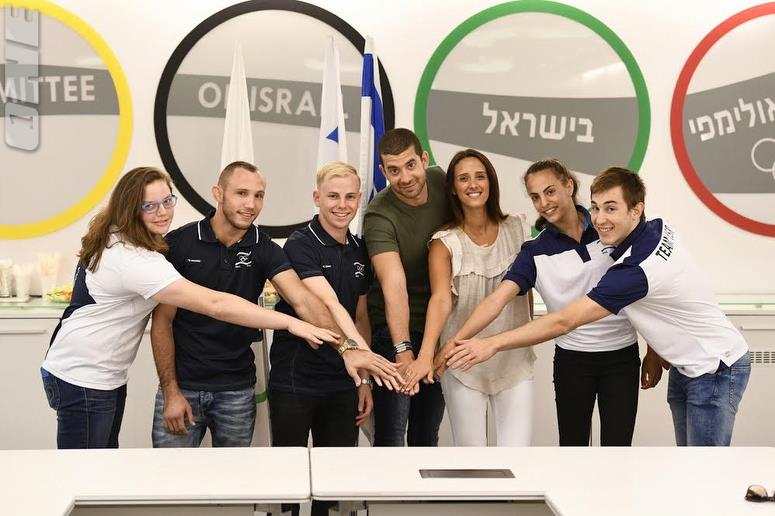
Oren Shabat Laurent (centre) and his wife Sivan Laurent sponsor State of israel's 2020 Olympic hopefuls (Courtesy Olympic Committee of State of israel)
Smallbones recalled that the back-and-forth disputes around the commodity were exhausting.
"There were discussions on the Wikipedia word pages with thirty different people writing all at once, all on the same topic. It was totally impossible to figure out what everybody wanted. There were some people who would place themselves as Banc De Binary and others who didn't identify themselves simply were obviously very biased in favor of Banc De Binary."
Smallbones said it is hard for volunteer editors to compete with paid promoters.
"It'southward extremely frustrating when people who are obviously paid are trying to distort information and we're almost all volunteers. When someone can put 5 people on an article information technology's very difficult for usa to stop them — at least in the curt term."
A five-figure fee for Wikipedia 'crunch direction'
In June 2014, a Wikipedia editor mentioned on a talk page that he had witnessed a new record in how much money someone had been offered to practise "crisis direction" for a Wikipedia page.
The editor described "a contempo contract to edit a unmarried Wikipedia article, where the winning editor won the contract after charging something in the 5 digit range."
The Wikipedia page in question was the Banc De Binary page and the five-figure sum was offered on a freelancer site to anyone who could rewrite the article in a way that removed the negative coverage, Smallbones told The Times of State of israel.
"Banc De Binary is hilarious," another editor wrote in response to the kickoff editor'due south revelation. The Banc De Binary Wikipedia page "was written by a paid editor (since banned) as a whitewash, and then Wikipedia editors got hold of it and converted information technology to a truthful article about what is clearly a very dodgy company. At that point, socks en masse descended to try to 'fix' it for the company, and when that didn't piece of work, more adverts to delete or revert the content appeared."
Banc De Binary logo
But Smallbones said the reality wasn't funny at all.
Kickoff of all, he estimated that nigh 300 people visited the article'southward dissimilar linguistic communication versions per twenty-four hour period, and he wonders how many of those, seeing positive statements, went on to trade with the company and lost money.
Second, he wonders how many hours of unpaid labor Wikipedia editors spent on "cleaning up" the commodity.
"Their paid editors probably put in well over 100 hours on the article. And nosotros had to put in as much fourth dimension every bit they did, even more, because if nosotros want to correct something, often we right it two or iii dissimilar times because there are a few editors with dissimilar points of view."
"I'll see something I don't like and I will correct it and someone will correct me and someone will say that's non quite correct and right them and so Banc De Binary will come along and put in something else. It's very labor intensive."
On May 17, The Times of Israel reached out to Banc De Binary'due south founder Oren Shabat Laurent for a response to the allegations in this article simply did not hear back from him.
Binary options, forex and paid editing
Banc De Binary is non alone. Smallbones said that paid editing on Wikipedia is rampant in the binary options and retail forex industries. Many Wikipedia manufactures for such websites go deleted soon later on they are put up, he said, because Wikipedia administrators strongly suspect they are created by paid editors for advertising purposes.
In a mail from September 2016, a Wikipedia editor recommended several binary options and forex company pages for deletion (only an administrator, a Wikipedia editor with special privileges, can perform the actual deletion), because the editor believed the entries had been created by sockpuppets or suspected paid editors. These included entries for binary and forex firms Spotware Systems Ltd., XM.com, AnyOption, IQ Pick, and JustForex.
"All the manufactures named higher up have been badly polluted by promotional editors and need a checkup," the editor wrote. "One thing I noticed beyond the multiple articles is a heavy trend to cite how well regulated the various companies and exchanges are."
All the entries mentioned above were subsequently deleted.
Polluted content that can injure your pocketbook
Wikipedia is just one of many forums where some binary options and forex companies get to nifty lengths to create "fake news."
Fraudulent binary options firms also employ an regular army of SEO (search engine optimization) specialists, who ensure that the warnings of government regulators or negative printing are buried far down in Google search results. (Final year, afterward The Times of Israel published several articles describing the widespread fraudulent in the binary options industry, 1 employee wrote to us complaining that "yous are ruining the keyword 'binary options.'")
But beyond that, some in the industry create faux news sites with an ostensibly large readership, featuring ostensible news reports that appear in Google News about the purported advantages of binary options trading.

Slide from a lecture by Google to the binary options and forex industry at the IFX Expo, May 2016 (Hunter Stuart/Times of Israel)
The industry also spends a fortune advertising on Google, Twitter and Facebook.
Some firms pay for sponsored content on mainstream news sites, hire expensive lobbyists and PR firms, cozy upwards to politicians and donate money to charities. Some companies have managed to get their ain executives to appear as talking heads on mainstream tv set financial programs.
Some binary options companies take been known to make threats combined with offers (known as throffers) to individuals who post negative information about them, offering to refund part of their investment money if they accept downward their negative review, or if not, suggesting menacingly that "we know where you live." Still other companies simply disappear from the internet equally soon equally the number of complaints mounts, but to pop up once more under a different name and website.
A Russian connection?
If some of these efforts sound reminiscent of the recent outbreak of fraudulent and polluted content stemming from Russia, among other actors, this may be because the binary options manufacture has a significant Russian component.
Across the Israeli telephone call centers and marketers who commit binary options fraud, many of the investors or ultimate beneficiary owners of binary options companies are Russian. Several of the banks where investors' coin goes subsequently their credit cards are processed are Russian-owned, including but non limited to the Russian Commercial Bank in Cyprus, Sberbank, and VTB Bank in Georgia. Several Russian-endemic forex companies, like Forex Social club and Main Forex, have partnered with the Israeli platform provider SpotOption to create their own binary options brands, such as option4trade and mfxoptions.
https://twitter.com/webzilla_com/condition/603470529987620864
A number of Russian-linked binary options firms, like option4trade and IQ Option, are hosted by the Russian-endemic web hosting visitor Webzilla. Webzilla, whose owner Alexey Gubarev recently sued Buzzfeed for publishing his proper name in the unverified Trump dossier, has made no underground that forex companies are among its major clients. A number of these clients have been placed on government regulator warning lists.
IQ Selection has been placed on an investor warning blacklist by the Monetary Authority of Singapore. Forex Guild was the field of study of a regulator warning from Belgium'south Financial Services and Markets Authority (FSMA) in 2015.
'In the end, nosotros volition prevail'
As for Smallbones himself, he is a retired professor of finance and a onetime foreign currencies trader on the Chicago Mercantile Exchange who lived and taught in Russia and Hungary during the 1990s and 2000s.The retail forex industry, as well equally its many fraudulent players, start came to his attention then.
""I remember being in a little town in the Urals where all the factories had been airtight. Posters were advertising forex trading with a $5 minimum deposit. The poor people who answered those ads had no chance of making any money," Smallbones said, "merely were probable going to be suckered into losing hundreds that they couldn't afford.
"There were similar scams in Moscow in the 1990s, only with more coin involved."
Every bit for how the binary options scam started, Smallbones waxed philosophical.
"Securities scams go back forever. The original Ponzi scheme was in the 1920s and information technology involved international postal coupons. And so in the 1960s people were scamming with warehouse receipts for salad oil. Annihilation that tin exist changed into coin, there is a scam associated with it. People just await at forex and meet all the tools needed are at that place to create a scam."
Smallbones is drawn to edit Wikipedia articles nigh financial fraud considering the topic interests him. Only he regrets that it took at least iii years to go the Banc De Binary article to a place where he feels it is accurate and off-white.
If that'southward how much work was required to correct i small example of fake news, Smallbones was asked, how tin companies like Google or Facebook, which rely heavily on algorithms as opposed to humans, go on the fraudsters at bay?
Smallbones replied, "Yes, well, virtually Wikipedia editors would probably concord that they can't."
He was more optimistic most the power of Wikipedia to root out lies and paid spin.
The scammers "tin can make trouble and make u.s.a. work a long time," he said, "only in the long run, and this was a very long run, we're going to prevail."

Banc De Binary Trading Competition,
Source: https://www.timesofisrael.com/wikipedia-vs-banc-de-binary-a-3-year-battle-against-binary-options-fake-news/
Posted by: lindseytiervil.blogspot.com
0 Response to "Banc De Binary Trading Competition"
Post a Comment